Showing posts with label food happenings. Show all posts

Tuesday, April 7, 2009

Chef's Blade


So, little while ago, I told you that I had started a new job and that I would write about it in posts to come, so here is that post.

Chef's Blade is a social networking site for professional chefs and the rest of the culinary industry. What does this mean? Well, Chef's Blade has culinary news and food writing coupled with a social networking platform that lets users both comment on the content but also get to know each other. So basically, it's like facebook for chefs and other culinary industry professionals and enthusiasts with news, writing, and quizzes thrown in--our quizzes are much better than facebook's.

What does this make my job? Well, amazing. Basically, I source food and chef related content, write about food, and talk to chefs and culinary industry professionals about their jobs as my job, all the while trying to make this endeavor that I'm really excited about successful...not to shabby, and by not to shabby, I mean, the best job ever.

And so here's my plug: Please join Chef's Blade, if you haven't. I'll make you tasty food if you do :) (YUMZZ...I know even more about tasty food now with this new job...)

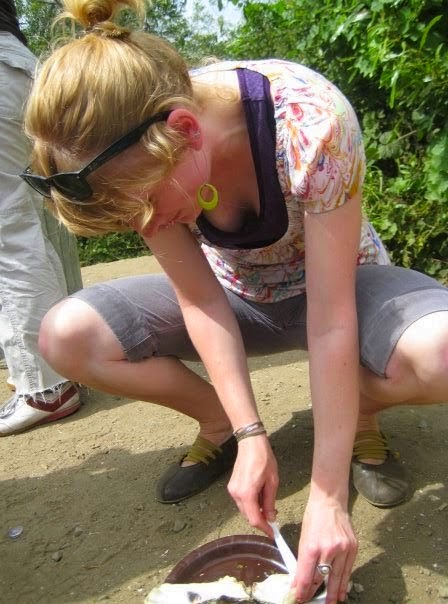
(Also, as a little FYI, that is indeed a photo from Katie Kwan of kitchensidecar; she's one our feature writers! Wowzers!)

Tuesday, March 10, 2009

What Foraging, Permaculture, and Dumpster Diving have in common

So I realize: I've been very, very bad blogger. I'm sorry. But, I have a good reason.
My job has changed (as in my 9-5 one), as many of you know, and I'm now working on a social networking site for professional chefs and other individuals in the cooking industry, which is called Chef's Blade. I'll write more on it later, but the transition has been a twee bit of worky work, and well, it's exciting, but it's made me a bad food blogger.

But, anyways, back to the task at hand: Foraging.

Forage SF has been organizing the Wild Kitchen, which, so far, has been a mini series of foraged meals; the first one they had was Valentine's Day and the last one they had was this past Saturday. Both were amazing amazing and delicious. Foraged food, boiled down to the essentials, is food that has been gathered from naturally-occurring places instead of, say, farms.

Forage SF is a foraged food co-operative, whose goal is to collect foraged foods both from the urban environment – for example, from fruit trees in backyards and sidewalks – but also from the surrounding Bay Area and distribute it to its members. The foraged food movement has grown out of a desire to challenge our dependence on industrial agriculture and to begin using the foods naturally available to us again. For me, what is most interesting about foraged foods is the dialogue it creates with our agricultural system, not to mention the questions it raises concerning what classifies as “foraged”.

During the first dinner I attended, Forage SF gathered the food from a variety of sources. Some of the greens – such as miner’s lettuce, mustard greens, and wild nettles – were growing naturally in the Presidio while other ingredients, like the acorns used in the acorn ice cream, were foraged by local foragers, such as FeralKevin. All of these ingredients were noticeably fresher and more flavorful than anything from the Ferry Terminal farmer’s markets. Sad. But maybe I should just "shop" at the park at the end of my block?

Personally, the most exciting aspect of these ingredients is that they grow naturally and without the interference of human cultivation. In addition, foraged foods grow sustainably in that they are part of the natural ecosystem already in place; foraging and consuming wild foods is thus part of the ecosystem itself as long as the consumption is not greater than the wild food supply.Herein, however, lies the catch: It is not possible to feed the world’s population on foraged food. Enter: Agriculture.

Currently, most of our food comes from monocultures, in which farms produce one type of crop over large areas of farmland. While agriculture’s use of monoculture has enabled us to feed our ballooning population, it has also led us to eat only a few food types. In addition, monoculture has caused massive crop failures, such as the Irish Potato famine, due to a crop becoming susceptible to a specific pathogen during a growing season. Permaculture, in comparison, seeks to design man-made systems after nature ecological systems. Polyculture, for example, grows multiple crops on the same agricultural space, mimicking plant ecosystems. While foraging wild foods will never be able to feed our large population, it does remind us of the importance of respecting the rules of the natural ecosystem.

Back to the first foraged dinner: The main course of last weekend’s meal was elk, wild boar, and venison. What I find interesting about foraged meat, besides being totally tasty, is the dialogue around foraged meat. For some foragers, foraged meat must be found already dead, while for others, foraged meat is wild game that has been killed by the forager in its natural habitat, the sum total of hunted animals never offsetting the natural balance of the ecosystem. Thankfully, the meat at this dinner was not found dead, as I’m not sure my almost-always stomach of steel could handle the extra “gaminess” (read: bacteria) that could be found in the prior type of foraged meat.

I want to take a bit of a tangent at this point to talk about freeganism, a new food movement that has arisen in New York out of a desire to “forage” for free food within the urban environment. Freegans “reclaim waste” left by the “capitalist society” from dumpsters outside supermarkets and restaurants (also known as Dumpster Diving), as well as forage for wild foods like mushrooms in city parks. The movement is centered in New York City but, with the recession, it has become more and more popular in other urban areas. To me, eating food out of a Dumpster is strange. It’s not something I would ever do; I like to know where my food comes from and diving into a Dumpster for almost expired milk and eggs doesn’t exactly fulfill my desire to know if the chicken and cows producing my food are treated well. Still, freeganism has a core value I do understand: We, as a population, are wasteful and we don’t always take advantage of the foods that are readily and freely available to us.

For me, the foraged food movement, coupled with permaculture and freeganism, teaches a lot of lessons. As I said at the beginning of this article, the world’s population could not be fed entirely on foraged foods. This does not mean, however, that the population shouldn’t be fed partially on these foods. As our food system has become increasingly complex, it appears we have forgotten that we can grow edible plants in our backyards, our fire escapes, and flower boxes and that food sources such as wild mushrooms, greens, nettles, and other edible wild plants grow naturally in our parks and are there for the free taking.

Foraging, permaculture, and feeganism produce very different food but all challenge us to consume the foods that are available to us and not to waste the foods we have. In addition, wild foods as well as foods grown in polyculture are certainly tastier than our average food source.

I find it hard to fathom, however, that freegan food has anything on wild boar.

PS. Was this post worth the wait?

Monday, January 19, 2009

Alice Waters didn't vote for 42 years!

Following up on my post Art. Food. Give. there was an article in the Huffington Post this past week reporting that Alice Waters didn't vote for 42 years! In 1966, when Waters' journalist-activist friend Bob Scheer lost his anti-Vietnam primary challenge to the Democratic establishment's congressman, Waters vowed to not vote again, until this past year when Clinton and Obama came forward as two possible presidential candidates. Waters raised big money for Obama as well as some funds for Clinton and is now hosting a fundraising dinner tonight in honor of Obama's inauguration that will raise money for two D.C. soup kitchens. So, after 42 years of politic abstinence, Waters finally cast a ballot this past November for our President-elect Barack Obama and become a responsible citizen once again. While I do obviously agree with her presidential choice and her food ethos and applaud her for organizing this inauguration event, I think abstaining from voting is a pretty weak way to influence politics. So let's hope that this time, since Waters' choice candidate did get elected, she will continue to vote like I believe a responsible citizen should.

Saturday, December 27, 2008

Art. Food. Give.

Add to the list of most sought after inauguration events, Alice Waters will be "cooking" a dinner for 80 people on January 19th; the tickets are $500. We all know, however, that Alice doesn't actually cook herself (way to do your research NYT); she just tastes and tells her cooks if it tastes good. In addition, other renowned chefs, who do actually cook themselves, have also agreed to participate in the event and will be cooking dinners for 20-30 people in homes around DC on the same night. In addition, several arts related guests will be in attendance, including Maya Lin.

The event is called Art. Food. Give. and proceeds will benefit D.C. Central Kitchen and Martha's Table, which both operate soup kitchens and help to run FarmFresh Markets, which gave 17,000 pounds of food to emergency food providers during its first year. In addition, in keeping with Water's rhetoric for locally produced foods, the ingredients for the dinners will come from local and sustainable farms. In addition, Alice Waters' organization of this event is significant considering her role in trying to persuade President-elect Barack Obama and Mrs. Obama to plant a victory garden on the White House front lawn. Her role in "cooking" this inaugural dinner indicates her possible role in shaping food and agricultural policy in years to come. Let's hope at least.

Sunday, November 30, 2008

The Anti-Restaurants, Bay Area Style

In a recent New York Times, I read an article about the underground eating clubs, which I only vaguely knew about before. These "anti-restaurants", as dubbed by the New York Times, work to challenge the way we eat food. The eating club highlighted in the NYT article invited eaters, mostly from Brooklyn, up to a farm town 30 minutes outside of Ithaca, NY for an all day affair that began with butchering a boar at an ungodly pre-brunch hour and ended with a six course meal. Throughout the day, the participants learned how to make pasta, use hydrocolloids to make fluid gels, and improved their knife skills, strengthening the farm to table connection.

When I read this article, I got incredibly excited about the idea of these eating clubs and signed up for the listserve of the Bay Area based Ghetto Gourmet and two Sundays ago I participated in my first underground eating experience. I went with three friends and a tasty bottle of Honig wine to the address we were emailed two days before the event, just to add to the mystic. Each dinner the Ghetto Gourmet does is at a different location, which on one hand adds to the adventure and mystery of it, but on the other stops the organizers from getting in trouble with the food and wine board. Anyways, upon entering a stranger's home and taking our shoes off, we were greated by the host and told to take a seat at oneof the low lying tables around which the other guests were already sitting indian style.

At our table were several other guests already, and we began chatting with one woman from Minneapolis and a 20 year old tween from Westchester, NY along with some other folks. Eventually the food started coming out. The first course was a beet salad with a light vinaigrette. The second and third were a spicy pumpkin broth based soup and a polish chicken dish, respectively and dessert were thin, crepe-like pancakes with rose petal syrup (yes, with rose petals still in the syrup--the chef for the night had picked the petals from his in-laws bush and put them in simple syrup a few weeks before). All were tasty, but truthfully nothing really wowed me.

What was amazing and wonderful though was the random people you meet while sitting at your table. Half way through the meal, the tables were switched up and you were at a table with entirely new people. It was a wonderful experience talking to total strangers about their lives, about how they got to San Francisco and this underground meal, and about the meal itself. What was anti-restaurant about this meal was the deliberate strengthening of the community formed over the meal; at the end of the night, I ended up driving a couple home, along with the three other people I already had in my car.

Tuesday, September 16, 2008

The Slow Food Taste Pavilions: a Glutonous Display of Food

One of the other events I participated in during Slow Food Nation was the Taste Pavilions. My ticket for this event was a whopping $58 after getting a discount from the original $65 via the Whole Foods discount. When my friend Lora and I arrived at Fort Mason, where the Taste Pavilions were being held, however, we were taken aback by the abundant display of delicious foods and suddenly realized that our $58 was money well spent.

The organizers of Slow Food Nation convinced local architects to create designs to convert one of the Fort Mason warehouses into a series of food specific rooms or "pavilions" where visitors can taste and learn about artisan versions of their favorite foods. Taste wise, my favorite of all of the pavilions was, by far, the ice cream pavilion. There were two "flights" of ice cream scoops, and I chose the Dark Chocolate, Olive Oil, and Fresh Blueberry flight, which was most definitely the best of the flights. The chocolate was creaming and wonderfully flavorful, the olive oil subtlety sweet and extra creamy with the fat of the oil, and the blueberry actually tasted like blueberries--what a concept!

My other favorite pavilions were the Olive Oil, Chocolate, Fish, and Wine, each for different reasons. The Olive Oil pavilion was in my opinion the best designed of the pavilions: the designers used everyday construction materials such as orange netting, raw wood, and crates to create a beautifully lit space that truly transported you away from the rest of the pavilions. More specifically, the front of the pavilion was occupied by a tasting station while the back of the space was equipped with an educational space where trained olive oil experts told about how to properly taste olive oil, which is a process reasonably similar to wine tasting, just involving smaller tastes (I mean, would you really want to drink a glass of olive oil in one sitting?). This pairing of spaces made it nice to go back to the tasting part of the pavilion so that you could taste each olive oil, knowing which undertones to look for. The chocolate pavilion was great because of the variety of tasting they gave you; it was also interesting how the flavors of each chocolate changed as you ate the other pieces, your taste pallet changing with each bite of chocolate. The wine pavilion, while not a wonderfully designed space, was wonderfully fun to go to with my friend Lora who can look at an absurdly long wine list and pick out the most expensive bottles to try, and boy, were some of them amazing. The fish was also a delicious stop for the creativity of each dish and was especially tasty after the disappointing charcuterie pavilion.

And so yes, the charcuterie was very disappointing. While the prosciutto we had was tasty, but it's pretty hard to have prosciutto not be tasty. We were also given beef jerky (really?) and something that resembled pate, but wasn't. Each were fine, but none had any wow factor. Charcuterie truly was a pavilion with so much potential (just off the top of my head, why no lardo?) that was totally not taken advantage of, while also in the midst of other pavilions that were totally pushing the envelop of their respective food products.

One of the most fun parts of the night, however, was are mistaken crashing of the employee party. After the official ending of the Taste Pavilions at 9, people congregated outside the event in front of the beer pavilion, and Lora and I thought it appropriate to join them. Eventually, it went on past 10 and a lot of people had left, and those remaining started to ask us which pavilion we had worked in. After enough people asked us, we realized we were in fact crashing the staff party, which was more than fine with the good natured foodies. The great part about the party was that all the beer, bread, and opened bottles of wine not used during the event were now being given out for free for all to take, which we might have taken advantage of just a bit.


Relating this back to the Slow Food movement as a whole, Slow Food is often criticized for being an exclusive or bougie movement; due to the expensive price of the ticket for the pavilions, this point is valid. While it was a wonderful experience to taste such delicious food, the polished designs of the pavilions, the high end food products, and the well dressed visitors seemed a little removed from some of the movement's "roots". On the other hand, having such a celebration of food brings delicious food and the necessary steps to obtain this food (good, clean, fair being the moto of the slow food movement) to the attention of a greater public than it would have otherwise. In this manner, it is great that it is more prevelent to be a conscientious food consumer but I would agree with one of the speakers I saw in a panel during the weekend (which will be the subject of my next posting) who said that one of the greatest obstacles to the movement is fashion. As fashions change and flux, we do not want the slow food movement to be a fad that will simply pass with time.

Also, I should mention that Alice Waters was there. She signed my ticket. Swoon.

Wednesday, September 10, 2008

The Victory Garden in Civic Center Plaza

I want to devote this post to the Victory Garden in Civic Center Plaza, which I find to be the greatest contribution Slow Food Nation had to San Francisco as a whole. Victory gardens, also known as war gardens or food gardens for defense, first came about during World Wars I and II as a response to the pressure on the food system brought on by the war efforts. These gardens produced food (vegetables, fruits, herbs, and livestock) and were planted at private residents as well as in public spaces-- Eleanor Roosevelt raised sheep on the White House front lawn in 1943. These victory gardens produced up to 40% of the food consumed nationally and helped to lower the cost of produce, thus allowing funds that would have been spent on food to advance the war effort in other areas.

The victory garden planted in front of the San Francisco Civic Center was funded by the City of San Francisco and redefines the "victory"
used in the gardens of WWI and WWII;
this garden, as well as other present victory gardens, was developed to increase urban sustainability. In the context of our food systems being stretched across longer and longer distances, the San Francisco Civic Center Victory Garden encourages SF residents to look increasingly local for their food supply. The resulting garden in Civic Center plaza was also aesthetically pleasing and biologically diverse. The circular beds included many local plants, included some rumored poison oak, as well as plants that have become staples of our California diet. In addition, a compost display could be found at the back, encouraging visitors to continue to reuse their food.

The San Francisco victory garden is also part of a larger movement of victory gardens that are encouraging citizens to look locally for their food. Additionally, there is a petition circulating to encourage the next president of the United States to plant a victory garden on the White House Lawn, hearkening back to Eleanor Roosevelt's time. Coupled with this movement, there is a growing network of people campaigning for the creation of edible landscapes, be it on the White House lawn or in your very own backyard.

In any event, the Victory Garden on City Hall's lawn was by far the most visible and accessible part of Slow Food Nation. San Francisco Mayor, Gavin Newsom was also affected by having the front lawn of his office become an edible landscape and is now working on developing San Francisco's first food policy, to be released in the next several months. While trying to feed the entire city, including public schoolchildren, homeless people, jail inmates, and hospital patients with an all organic, locally grown diet via public funds seems a bit financially unrealistic, the thought to start working towards creating the infrastructure to produce our food locally is a great one.

Also, watch Roger Dorion's "Eat the View" video, his campaign to the next United States President to make the White House lawn a victory garden:

Friday, August 29, 2008

On the Eve of Slow Food Nation!

Well, sort of the eve, for me at least...

The first day of Slow Food Nation was officially today, but I am attending my first event tomorrow. Much hoopla in the city and my own personal excitement has led up to this event, giving me heightened expectations and some mixed feelings. Visitors have to pay for most events and many are rather pricey with a lot of them having already sold out. While their selling out and the proceedings going to the international Slow Food nonprofit is exciting, it does seem a little exclusive to have so many of the events at seemingly cost prohibitive prices. I know I have written about how it is good that a bourgeois culture is adopting many of the slow food concepts into their lifestyles, but I do think having the celebration of the slow food movement being costly to the individual is a bit contradictory, or has the potential to be at least.

I don't want to say too much, however, before I attend my events. My first stop tomorrow will be volunteering at CUESA (not exactly SFN sanctioned, but in the same vain), and then to the victory garden, followed by the Slow Food talk at 4 pm. On Sunday, I'm going to be going to the Sunday night taste pavilion with a possible jaunt at the Slow Food Rocks concert, but we'll see. Next week, I will have plenty to write about I am sure!

Wednesday, August 27, 2008

The Ice Cream Man!

About two years ago, I had my first run in with the Ice Cream Man at a concert in SF, and it was a totally glorious surprise. The Ice Cream Man travels around the country giving free ice cream away to individuals, because "it makes people happy." The funding for this venture comes from advertisers, sponsors, advertisers, and promotions, and, to date, Matt Allen, the founder, and his crew have given away 125,000 treats. Yesterday, I had my second time with Matt Allen, the founder of Ice Cream Man, and the experience could not have been more splendid.

I love ice cream; my first job was in an ice cream shop and after two years of free ice cream and ten pounds gained, I still loved the creamy, icy goodness. Partly nostalgic and partly glutenous, my love of ice cream lives on, my favorite spot in SF being Bi-Rite Creamery where I will often suggest meeting for an after work cone to replace the after work drink.

Yesterday was a beautiful day in South Park, and, after enjoying a tasty chicken and blue cheese salad from South Park Cafe, the Ice Cream Man arrived at 1:30 pm and my friend Peter and I joined the line of South Park techies and Current employees. I got an ice cream sandwich while Peter for one of those cones things with the chocolate on top. On such a hot day, it was so lovely to cool off with those cool, creamy bights; this coupled with the novel surprise of free ice cream at my usual lunch spot, I left my lunch hour a very happy camper. Ice Cream Man, you make my day.

Wednesday, August 20, 2008

It's as if the NYT was reading my mind...

In today's NYTimes, April Dembosky writes about P.S.1's Public Farm 1, which I wrote about my posting yesterday. The article, entitled Fun on the Farm Down Home in Long Island City, discusses in more depth P.S.1's weekly Warm Up event and the interactions that occurs between the visitors and the urban farm during these happenings. A few things I learned while reading the article that I wish I had known while I was visiting is that you can actually pick the plants and lay on the grass filled cylinders. When I went on a quiet Friday afternoon with my friend Danish, we were frequently the only people walking around the structure. I think with more people filling up the space, visitors begin to naturally experiment. With only a few people in the space, one is conscious of being outside an art institution and our trained sense to not touch "art" prevails. If only I had known, I could have actually eaten those strawberries! Thanks NYT for the follow up...

Tuesday, August 19, 2008

P.F.1

On a recent trip to New York, I visited my ever favorite art space, P.S.1, excited to see this summer's courtyard installation. This year, the architecture project chosen for the MoMA/P.S.1 Young Architects Program was WORK Architecture's P.F.1. P.F.1, standing for Public Farm 1, is an urban farm space constructed of large cardboard tubes that form a v-shaped plat form that dips in the middle around a central pool. The top surface of the structure acts as a working farm, producing produce and plants that are used in P.S.1's cafe as well as sold at an "absurdly local" farmer's market right in front of of P.S.1's entrance. The structure as also built totally of recycled materials, is powered 100% by solar power, and utilizes rain water for irrigation, bringing together sustainable agriculture with sustainable construction.

In addition, P.F.1 includes a small chicken coop as well as some fun interactive features. I particularly like the chicken coop; it smelled clean and had lots of space per chicken, obviously standing in stark contrast to any industrial farming chicken coop--these were happy chickens! There were also recordings of farm noises, such as cows mooing and sheep baaing, which were probably intended for little kids judging by how low they were to the grown, but were pretty darn enjoyable to play with during a Friday afternoon.

What I really liked about this project is how it makes principles of sustainable agriculture not only accessible in an urban environment, but visually engaging. In addition, I like that during the Saturdays of the summer season, New York's hipsters will be gathering in the quirky urban/agricultural space during Warm Up, making sustainable agriculture just a little bit cooler. So, if you're in New York at some point before September 15th, I would suggest visiting this rather nifty Urban Farm! Maybe you'll catch little kids swimming in the pool like I did...which I thought was a little strange, even if it was hot...

Tuesday, August 5, 2008

Flavor Tripping: not quite as trippy as expected

A few months ago, I, along with many other readers, read the NY Times article about the miracle fruit that causes flavor tripping and have been pretty captivated by the idea for the last few months. After eating a piece of miracle fruit, one's taste buds are rewired for an hour or so rendering sour flavors sweet. Yesterday, San Francisco had its very own flavor tripping event, and I bought my ticket as soon as I heard.

So, after several months of dreaming of the miracle fruit and its miraculous affects, my expectations were reasonably high and were only heightened when I got there and the line reached the end of the block. After reaching the frontSo, after several months of dreaming of the (which didn't take very long as my very nice friend Peter had gotten there earlier and had done the waiting for the both of us), I was given a little, purple poach containing the fruit and instructions to swirl the fruit in my mouth for at least one minute but preferably two. While I was moving the fruit pulp around my mouth, a felt a slight tingling sensation across my tongue which resulted in something that felt like a partial numbing. Believing that I had begun tripping, I went straight for the bitter citrus, lemons and limes, and, well, they tasted like candy. The sensation of seeing something you have always known to be tart and bitter, even when sweetened, and tasting it as being totally sweet with very little hint of the usual bitterness, was totally bizarre! After this, however, the craziness of the effect was much less extreme. Grapefruits and pineapples simply tasted extra sweet and delicious while many other things, such as salad dressing and unsweetened cranberry juice, were hard to even gauge how much their taste had changed, without knowing exactly how they had tasted before.

There were, however, a few things whose tastes were altered in surprising ways, namely oysters and balsamic vinegar. Oysters had a newly creamy texture, seeming to melt across your tongue, but still maintained their salty flavors; at the event, I likened them to creme fraiche with a whole lot of tasty caviar on top. Balsamic vinegar was also interesting because when it was in your mouth, the subtle, sweet undertones dominated while the bitterness of the vinegar vanished until it went down your throat and the vinegar taste came back to bight you. All told, the flavor tripping experience was pretty interesting, but the expectations set by the NYTimes article that I would suddenly be pouring Tabasco on my tongue as if it were maple syrup did not exactly hold up.

Monday, July 21, 2008

Summer Feast: A Gastronomically Gluttonous Meating

This past Sunday night, I had the gastronomic pleasure of attending the Summer Feast, co hosted by Meatpaper and Gastronomica. And what a bloody feast it was! Bloody in two senses: when I first arrived, around 6:30 pm, at Perbacco, the restaurant was packed and buzzing with food consuming activity; my instinct to compete for food against my fellow humans kicked in and the four of us that came together strategically divided in order to help the rest of the pack get the the most diverse food and drink samplings. And bloody in that some of the dishes incorporated blood in a way I had not tasted: pig's blood sausage and pig's blood chocolate pudding with pistachio mascarpone topping.

After much glutenous consumption, my three most favorite tastes were the bacon, pistachio marshmallows, the blood pudding--both prepared by Perbacco--and the chopped liver from Serpentine. The bacon/pistachio marshmallow had a sweet and fluffy initial bite that was quickly follow up by the crunch and salt of the bacon and the fatty sweetness of the nuts. The blood pudding was just cool to me because it had been made from, well, blood and it's nice to know that you are using the most of the animal as you can. And I also just love liver. It's the anemic in me, really.

Anyways, here are some photographs from the event; the first is an image of the marshmallows, the second and third are images of the chocolate blood pudding, and the final a picture of three bites from Perbacco, the upper right of which is the blood sausage: