Showing posts with label Michael Pollan. Show all posts

Friday, March 27, 2009

VICTORY!!!! (garden)


So, as of now, this might not be news to everyone, but I wanted to take a brief moment to acknowledge Michelle Obama's breaking ground on the White House Victory Garden, or the White House vegetable garden last Friday, March 20. It was a pretty exciting moment for the Food Movement as we were not only getting a victory garden on the White House lawn, or as close as we're going to get, but it seems we finally have an administration that is in support of reforming our food system. From Tom Vilsack proposing cuts in corn susidies as well breaking ground last month on the the people's garden to the appointment of Kathleen Merrigan, a long supporter of reform of our food system, as the Deputy Secretary of Agriculture, it seems, a food revolution is indeed in the air, as the New York Times apply said last weekend.

In the New York Times article Michael Pollan is quoted as saying that the food movement might not be ready to go "prime time". While I do agree, that it seems that in only a few short months, a movement that was once seen, by both itself and the nation, as an underground constituency is taking the hot seat. I would like to remind Pollan, however, that books such as his very own Omnivore's Dilema have educated Americans about what is wrong with our food system, and with rising energy costs and health problems nationally, I believe our nation is in fact ready to reform. To me, it seems that it not just the food activists that are powering this movement, but rather the government and the people themselves.

Also, the layout of White House vegetable garden is pretty amazing; I was sort of drooling over just the picture.

Thursday, December 18, 2008

Tom Vilsack to be Secretary of Agriculture

Over the last few weeks, there has been much buzz over and speculation about who President-elect Barack Obama would choose as the next Secretary of Agriculture; yesterday, Obama choose Tom Vilsack, a two-term governor of Iowa. To be blunt, I'm not pleased, but my opposition is a bit more nuanced than total rejection.

Leading up to Obama's choice for Secretary of Agriculture, an online letter had been circulating that encouraged the Obama administration to choose an Agricultural Secretary committed to reform, or, appropriately dubbed, change. Leaders in sustainable agriculture, such as Michael Pollan and Alice Waters, stepped forward to speak about their ideas on the role for the next Secretary of Agriculture. Pollan specifically suggested the position's title be changed to Secretary of Food to reflect the changes in our food system since the position was first created, when the majority of Americans were farmers, in comparison to now, when our system is based upon enterprise farms using machinery for farm labor. It is no longer our agricultural system we need to protect but rather the food these enterprises create for Americans to consume. All this advocacy and excitement created an air of hope for change.

Tom Vilsack is not the choice for change. He is from Iowa, a state focused on corn; he is part of the very system that is the problem in our food chain. Corn is a problem for a lot of reasons. Both Obama and Vilsack are supporters of using ethanol as a way to reduce our dependence on foreign oil; while using ethanol does reduce our use of foreign oil, it also raises the cost of corn (most ethanol in the US is made from corn), which in turn raises the cost of food as so much of our food includes corn and corn bi-products. Corn-based ethanol is also not a sustainable energy source in comparison with other bio-fuels such as sugar cane ethanol. In addition, corn farmers currently receive large subsidies to raise corn, which has led our agriculture system to become a mono culture and the majority of our food to be processed corn bi-products, due to the surplus corn produced. Nutritionally, this means Americans are not eating a diversity of foods, which leads Americans to not consume the diversity of nutrients their bodies require. This diet based on corn bi-products also means Americans are eating unhealthy corn bi-products such as hi fructose corn syrup; most of Americans health problems can be traced back to their unhealthy, corn-based diet. And again, I will say corn is a problem for many reasons.

Being from Iowa and a supporter of ethanol, it is quite probable that Tom Vilsack will be more of the same. Obama's choice of Vilsack is also considered a thank you to Iowa for the state's support of Obama in the election. To be fair, however, as Michael Pollan commented in this morning's interview of NPR Morning Edition, Vilsack has suggested caps on corn farmers subsidies and supports more food production on a local level. In addition, it is important to acknowledge Obama's choice for Secretary of Energy, Seven Chu, who is considered an early leader in alternative energy and, importantly, is opposed to ethanol as an alternative fuel. It is thus possible that Valsack's support of corn-based ethanol will be trumped by the Nobel prize winning Chu's opposition. I believe Pollan's statement of being "cautiously hopeful" is a good one.

And yes, the picture above is indeed of Tom Vilsack, our future Agricultural Secretary.

Friday, September 19, 2008

On what Slow Food actually means...

Leading up to Slow Food Nation I was often asked what "Slow Food" actually means. Each time, I found myself answering the question a bit differently depending on to whom I was talking; at first, I thought this was probably due to my not having a clear sense of the movement, but I think now that my various answers were pretty close to the movement's reality. Slow Food has a lot of meanings and origins, which is okay and pretty appropriate, as all these meanings lead to the same resolution of "better" food. The various definitions of what "better" means are why the movement has so many meanings.

Slow Food's motto is good, clean, and fair food. More specifically this mean, that the food we eat should taste good; the this food should be produced in a clean way that does not harm the environment, animal welfare, nor our health; and that food producers should receive fair compensation for their work. In a talk that I attended during the Slow Food Nation weekend, aptly called "Slow Food Nation",Wendell Berry, Vandana Shiva, Michael Pollan, Alice Waters, Eric Schlosser, and Carlo Petrini discussed what Slow Food meant, each speaker bringing a unique perspective on the matter.

Of the speakers, I thought Vadana Shiva brought the most thoughtful perspective to what slow food meant. She spoke most about the Slow Food movement in the context of the greater world food economy, about places were people do not receive the proper nutrition because of the way food systems are set up. Her most important conclusion was to not encourage developing countries to emulate the US food system but to continue to educate citizens on how to produce their own food so as not to become dependant upon other countries for food and to also continue to produce food locally. In addition, as I stated in an earlier blog post, she made the astute statement that the biggest obstacle to the slow food movement is fashion.

In addition, the statement that the slow food movement is a leaderless movement was made, which I also find very true and very interesting. Slow food is, for obvious reasons, a local movement. Much of what slow food strives for is that food be produced locally, which makes it as clean as possibly, often as good as possible (I mean, has anyone had a Haas avocado from South America taste as good as the ones grown here?), and also easiest to determine if the workers have been treated fairly. It's interesting, however, to consider how a movement without a clear leader has gained such an impressive following via grassroots organization.

Overall, I think that much of how an individual perceives slow food is dependant on where an individual lives. In the Bay Area, for example we mostly focus on good as much of our food is clean and fair (ie local with fairly paid labor). Also, there is a lot of culture developed around food here; from restaurants to farmer's markets to food magazines to underground eating clubs, a lot of time has been spent developing a culture around meals. Since moving to San Francisco, I can't remember having even stepped into a fast food chain restaurant for even a bathroom while I have also developed a digestive reaction to any fried food. In the Bay Area we thus have the luxury to reinstate the culture of eating meals communally as well as redefining what this culture is; in this manner, when I talk to someone from the Bay Area about what Slow Food is, I might focus on the cultural redevelopment of eating that is occurring with the slow food movement, but if I'm talking to a friend from Philadelphia who love cheese steaks I might talk about slow food being the opposite of fast food, and give a general overview of how in a "slow" meal you are more connected with the entire production of your food from seed to plate, thus standing in contrast to a fast food meal where you only really participate in the ordering of a grey meat patty. gross.

Friday, August 29, 2008

On the Eve of Slow Food Nation!

Well, sort of the eve, for me at least...

The first day of Slow Food Nation was officially today, but I am attending my first event tomorrow. Much hoopla in the city and my own personal excitement has led up to this event, giving me heightened expectations and some mixed feelings. Visitors have to pay for most events and many are rather pricey with a lot of them having already sold out. While their selling out and the proceedings going to the international Slow Food nonprofit is exciting, it does seem a little exclusive to have so many of the events at seemingly cost prohibitive prices. I know I have written about how it is good that a bourgeois culture is adopting many of the slow food concepts into their lifestyles, but I do think having the celebration of the slow food movement being costly to the individual is a bit contradictory, or has the potential to be at least.

I don't want to say too much, however, before I attend my events. My first stop tomorrow will be volunteering at CUESA (not exactly SFN sanctioned, but in the same vain), and then to the victory garden, followed by the Slow Food talk at 4 pm. On Sunday, I'm going to be going to the Sunday night taste pavilion with a possible jaunt at the Slow Food Rocks concert, but we'll see. Next week, I will have plenty to write about I am sure!

Monday, August 25, 2008

Foraging for Blackberries

This past weekend, I made a trip with my friends Katie, Liz, and Arianna to Russian River where we were also joined by our friend's Lisa, Brad, and Sarah. After a trip to the SF Ferry Terminal Market, we only spent a night at Lisa's newly renovated family home, but the food was delicious. While Saturday's dinner was scrumptious, I specifically want to talk about the wild blackberries we picked Sunday morning for breakfast.
Sunday morning we all woke up all in the mood for pancakes, specifically stone crushed oat pancakes with fresh fruit on top. We had some white peaches from the farmer's market that had gotten a little mushed during the car ride up, so were sliced into tasty morsels. Lisa, having been coming to this same place for her life, remembered the blackberry bushes around the corner from her house and suggested we pick some. Bringing a bowl, we reached through the prickly, vine-like bushes to reach the sweetest blackberries I had ever tasted. When they were especially ripe and delicious, they would crumble in your hands as you took them off, which I wasn't able to resist eating rather than putting in the bowl. Every once in a while, I grabbed a not so ripe one, which was reminiscent of the blackberries we are used to buying in stores. Also, the prickers on the vines surround the berries grabbed me a few times, which left a few small scratches on my arms and legs and one larger one on my sandal clad toe (it now bears a band-aid).I have also just finished the foraging section of Michael Pollan's Omnivore's Dilemma and felt quite the satisfaction about gathering my own food as he felt. I also felt a great connection with what I was about to eat, feeling that I was in fact responsible for each of those tasty bites I took.
In any event, fresh blackberries on top of stone crushed oatmeal pancakes was a wonderful beginning to a Sunday morning.

Wednesday, July 16, 2008

Michael Pollen and Grass Fed Beef

After yesterday's posting describing the new ingredients of non-grass fed beef's feed, I thought I should write a little more about why feeding cows grass is such an important thing to champion.

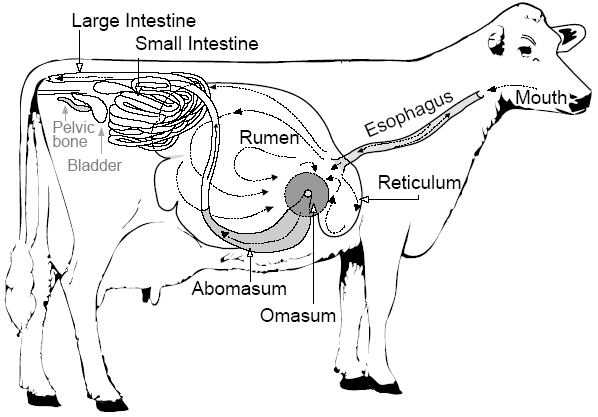
First of all, cows' ruminant digestive systems are well evolved to digest grass; the cow's digestive system has two stomachs, in which the food is softened first before being fully digested in the second stomach. In this manner, feeding cows food other than grass messes with their natural digestive process; one of the reasons why cows are given so many antibiotics now is because feeding them corn and other food that their stomachs aren't meant to digest causes an upset in their bodies natural chemistry, thus opening them up to infection.

Another important thing to note is that humans, among most other species without rumens, cannot digest grass. I am currently reading Michael Pollen's Omnivore's Dilemma and am reading the section where he visits Polyface Farm, which raises grass fed beef along with a whole slew of other livestock raised on their natural food. Without going into a long description of the merits of Polyface Farm, Pollen's discussion of the advantages of feeding cows grass, from the perspective of energy consumption, is one of the strongest arguments for eating meat. At Polyface farm, the cows are rotationally grazed, which means that the cows are allowed to eat in one area of the pasture before being moved to another area of the farm to eat the following day. In this manner, the cows partially eat the grass stem, but not the whole stalk. As a result, the grass grows back much faster than it would if the cows were allowed to stay on one plot of land for an extended period of time and ate the grass stalks to the ground. Because of this constant trimming and growth cycle, the pastures at Polyface Farm, and at other farms that rotationally graze their livestock, produce more biomass than the same plot of land would if corn were raised in its place. One of the strong arguments against eating meat is that great amount of food energy wasted every time an animal eats another animal (a 9 to 1 ratio), but in the case of cows that are grass fed, they are eating biomass from which we cannot glean food calories. In addition, the energy to grow grass comes from the sun, which means cows are, in essence, converting the sun's energy, through the venue of grass, into food energy that we can consume. And, importantly, grass fed beefy is mighty tasty.